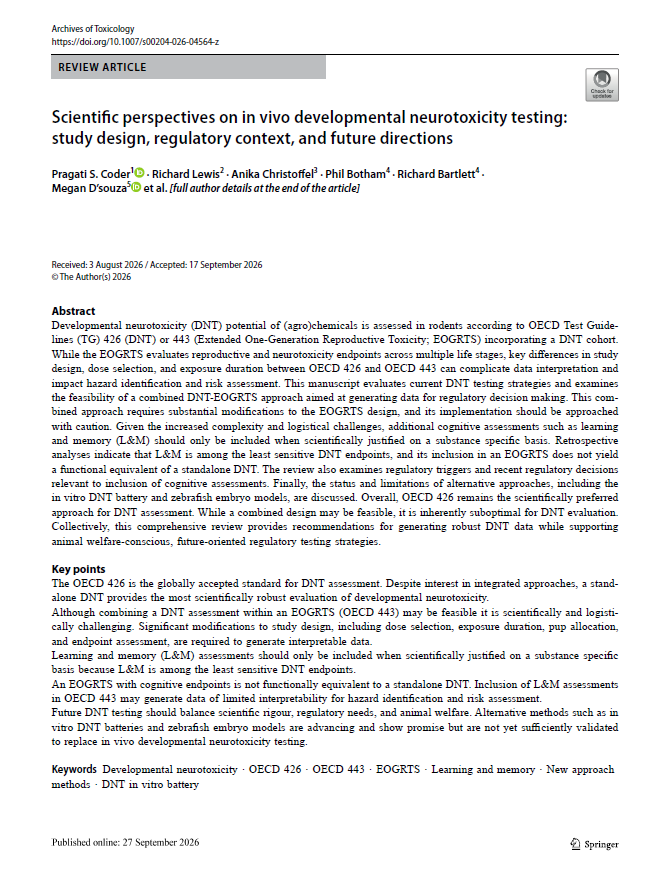
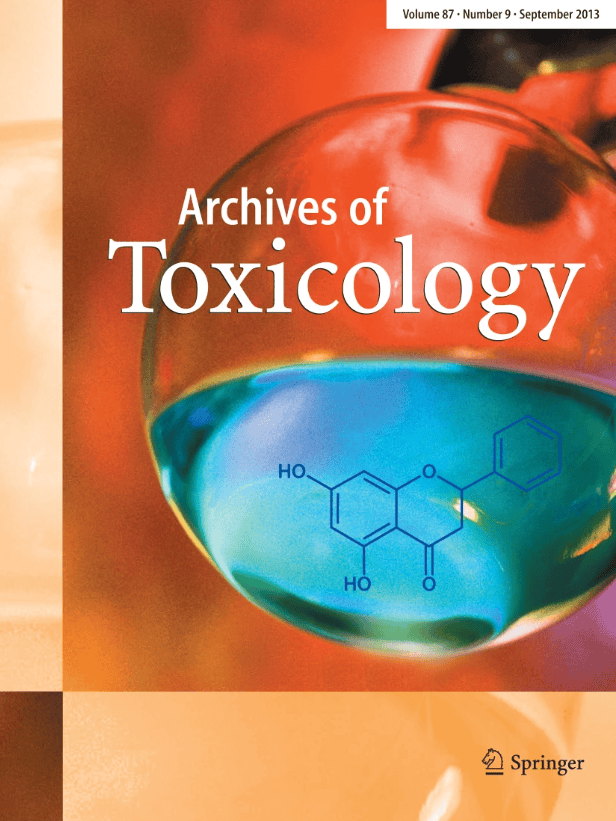
Brussels, 1 October 2026 – ECETOC is pleased to announce the publication of a new review article in Archives of Toxicology titled “Scientific Perspectives on In Vivo Developmental Neurotoxicity T...
We are pleased to welcome Talia Neal-Walthall to ECETOC as a secondee. Talia joins us to work on topics related to exposure, an area central to much of our current scientific programme. She will be wi...
This software was developed by a consortium of partners to facilitate the uptake of novel approaches to estimate aquatic threshold concentrations (e.g. the concentration at which 5% of the species are exposed above their EC50, HC5).
Why?
The Worker TRA Task Force has been active since 2019, delivering projects that advance the scientific basis of the Worker Targeted Risk Assessment (TRA) tool. Its overarching objective is to e...
Why?Regulatory assessment of immunotoxic properties of chemicals is a complex and challenging task
Limited regulatory guidance exists
Lack of industry and regulatory knowledge...
Why?Hazard and safety assessments for the pelagic compartment often rely on in vivo studies using a single fish species, raising ethical concerns and uncertainty in terms of extrapolation....
The ECETOC 7SI-ED is recommended as a tool to assess whether or not a substance possesses endocrine disrupting properties. It is based on robust scientific principles and has been designed to be pract...
This workshop explored the current state of the science on epigenetics and its role in reproductive toxicity. Experts from a range of scientific disciplines met over two days to share knowledge and br...
SUMMARY1. This expert panel was convened by ECETOC to discuss the issue of so-called low dose effects of endocrine disrupting chemicals (EDC), and to propose a possible research programme to throw...
TR 106 : Guidance on Identifying Endocrine Disrupting Effects | June 2009
Recent revision of the European directive on plant protection products (Directive 91/414/EEC) and new regulations concerning...
WR 16 and Addendum : Guidance on Interpreting Endocrine Disrupting Effects and Addendum | October 2009
Please note that this version of the report includes the addendum that was previously published...
Why?
Technical guidance is still missing in response to EU scientific criteria for the determination of endocrine disrupting (ED) properties (ECHA & EFSA, 2018), to identify whether observed ad...
Why?
The current development of NAMs in the field of endocrine disruption (ED) is very active as the concept of ED is evolving in various areas of toxicology including liver toxicity/xenobiotic met...







![Immunotoxicity assessment: Addressing Challenges and Advancing Methodologies [Workshop → Task Force]](https://www.ecetoc.org/wp-content/uploads/2026/07/Picture2-1024x923.jpg)